


Kengo Kuma: the era of wood
Built for 2020 Summer Olympics, the New National Stadium, Tokyo is rightfully supposed to be the architectural symbol of 2020. It is designed by the most delicate architect of the world's most delicate architecture – a Japanese master Kengo Kuma. With 70,000 ft³ of wood used for the stadium roof and 47,000 trees planted around the site, Kengo Kuma revives traditional Japanese architecture and presents himself as a technological pioneer of his time.
Kengo Kuma was born in Yokohama in 1954. In 1979 he graduated from the University of Tokyo, and it was only 1987 when he established his first architecture firm. It is symbolic that Kengo's aspiration to be an architect came from his swimming in the pool of the Tokyo Olympic stadium. The lights on the ceiling fascinated the young man, and this experience determined his future place in life.
 Kengo Kuma's Olympic stadium, Tokyo, 2019
  Kenzo Tange's stadium which inspired Kuma, 1964
During his career, Kengo Kuma faced the economical crisis in Japan. At that time, the architect was working in the provinces doing small projects. He worked along with local craftspeople and learnt the secrets of using traditional materials and ancient technologies. “I am part of the lost generation. We know what cultural stasis is. We had more time to think." Kuma noted that time gave him a strong push to restore traditional Japanese architecture: "The post-war generation of Japanese architects followed the United States' practice to use glass and concrete in construction. That was far away from Japanese traditions."

M2 building – one of the first Kengo's architectural projects, Tokyo, 1991
In the book "Anti-object: The Dissolution and Disintegration of Architecture", Kengo Kuma reveals his vision of the architecture main principle: a building should not conflict with the environment or dominate it, and architecture should not be uniform. It should belong to the landscape, grow out of it, and reflect the history and traditions of the area. This is the part of a shakkei principle ("borrowed scenery"), which fuses landscape and architecture. Japanese architects often rely on it. “Western architects bring their tradition everywhere while we build our projects on local traditions”.
 Victoria and Albert Museum in Dundee, Scotland, 2018
  China Academy of Arts’ Folk Art Museum, Hangzhou, 2015
"I think the vital point is how an architect handles space. It may be even more important than materials and technology. Whenever I start a project, the most important thing for me is the feeling a man gets inside." Kengo's architecture makes use of clear lines. The facades are flat no more due to the wooden planks. Kuma's buildings tend to be as low as possible and rely on local natural materials.


Great Bamboo Wall House, China, 2002
"It's time to recognize the role of materials in architecture. The architecture of the 20th century celebrated first form, then space, and then materials. In the future, materials will come forward. It is materials that come into direct contact with a man, a human body and affect it.» In his architecture, Kuma uses mainly natural materials to get the effect of transparency and lightness. He completely avoids concrete. In his opinion, concrete "kills" architecture.
His projects exploit wood, rice paper, bamboo, soft aluminum, unburned brick, and stone. The architect's vision is soft and flexible architecture without concrete boxes and flat surfaces. His buildings in no way seem solid and massive. Kengo Kuma is the head of a research laboratory where he studies the properties of materials. It contributes to high technological efficiency of his using natural materials – modern wood is as fire-resistant as concrete. Kuma believes that wood makes the future of architecture, and his incredible projects prove it in a brilliant way.


Nagasaki Prefectural Art Museum, 2001
Asakusa Culture Tourist Information Center is designed by Kengo Kuma's firm in 2012. The complex geometric building seems to be an integral part of the historical center of Asakusa. Wood defines the appearance of the facade and echoes traditional Japanese architecture. The building looks like a stack of small wooden one-story houses with uneven roofs.
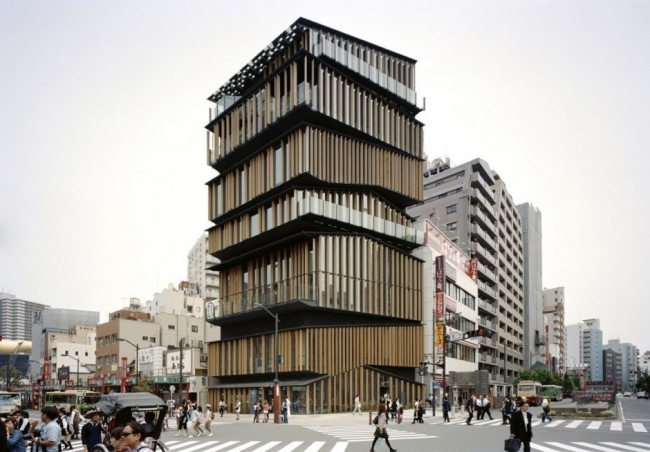
Asakusa Culture Tourist Information Center, 2012
The Sunny Hills shop design resembles a bamboo basket. Here is the traditional method used in Japanese architecture: vertical and horizontal beams of the same width intertwine and create a kind of lattice. The three-dimensional wooden structure wraps the building and makes it look light and airy.


Sunny Hills shop, Tokyo, 2013
In 2014 Kengo Kuma designed the University of Tokyo's Hongo Campus with the facade covered with hundreds of thin cedar wood planks. The walls seem to be clad with wooden "shells". The vertical strips are arranged in groups of five to ten and then laid out to form a checkerboard pattern.


University of Tokyo's Hongo Campus, Tokyo, 2014
Facades with wooden planks are the distinctive feature of Kengo Kuma's architecture. He kept it when designing an office building in Nagoya. The diagonal slats cling to the outer walls, and tall trees are planted all around the complex.


Office building, Nagoya, 2018
The first design for Australia reflects Kengo Kuma's permanent principle: "Our aim is to achieve architecture that is as open and tangible as possible to the community." "Wrapped" in 20,000 wooden ribbons, the Exchange building is an architectural landmark one can't look over.


The Exchange, Sydney, 2016
Odunpazari Modern Museum is located in the Turkish city of Eskisehir. It is a building of complex geometry with the timber beams covering the facade. The interior of the museum also includes wooden elements. The beams of the central atrium are at the core of the building. That's the local architecture principle realized: the traditional Ottoman houses nearby have these cantilevered wooden supports for upper floors that slightly protrude over the lower ones.


Odunpazari Modern Museum, Turkey, 2019
One of Kengo's latest projects is ONE@Tokyo—a hotel in Tokyo that reflects the local history and character. The hotel is located in the Sumida ward noted for its traditional Edo-era atmosphere. The building is concrete while the facade of the ground floor is decorated with timber planks—Kuma's vivid architectural signature.


ONE@Tokyo, 2017
Another hotel renovated by Kengo Kuma and Associates is Ginzan Hot Spring Fujiya. The original facade of the century-old building was redesigned as well as the interior. The hotel complex still has the charm of classical Japanese architecture, and now it has also acquired the expressive design features of the talented Japanese master.


Ginzan Hot Spring Fujiya Inn, Yamagata Prefecture, Japan, 2006
Suspended Forest is another original project of a residential building. The intricate design includes a lot of triangle elements coated with plywood panels. So the structure seems to float in the air. Each one of the external wooden pieces is manually cut so the wood will age with the house.


Suspended Forest residential building, Switzerland, 2018
Decorating interior with wooden structures is Kengo Kuma's recognizable style. His office has implemented several commercial real estate projects with admirable and fascinating concepts.
 Valextra boutique, Milan, 2018
  Kayanoya soy sauce store, Tokyo, 2014

Room design at the Kyoto Kokusai hotel, Japan, 2011
Kengo Kuma's innovations go beyond using classical materials in modern architecture. The master together with the forest conservation organization More Trees has designed an unusual item—Tsumiki Stacking Blocks. It consists of wooden triangle elements with V-shaped notches at the ends, which allow the blocks to nestle atop the other. That's the way to create unusual sculptures.


Tsumiki Stacking Blocks
In 1997 Kengo Kum received the Architectural Institute of Japan Award for the project of the Noh Stage in the Forest. DuPONT Benedictus Award for “Water/Glass” and Decoration Officier de L’Ordre des Arts et des Lettres (2009) are other Kuma's awards. In 2010 Kengo was awarded Mainichi Art Award for “Nezu Museum” in Tokyo. In 2011 he received he Minister of Education, Culture, Sports, Science and Technology’s Art Encouragement Prize for “Yusuhara Wooden Bridge Museum”. Now Kengo Kuma is a Keio University Professor and the author of many books and articles on the study and criticism of modern architecture. He is the author of the books "Losing Architecture" (Makeru Kenchiku), "Uniting architecture" (Tsunagu kantiku), "A New Debate on Cities: Tokyo" (Shin-Toshi Ron Tokio), co-authored with Yumi Kiyono; "A New Debate on Countryside: Tokyo" (Shin-Mura Ron Tokyo), co-authored with Yumi Kiyono etc. He has about 150 employees in his offices in Tokyo and Paris.
Author: Elena Belenkaya
